It’s BFCM weekend.
Traffic has been surging all day. Your ads are performing. Conversions are strong. The team is watching the dashboard in real time.
At 11:47 PM, just before midnight, a customer places an order.
It feels like a win.
At 8:12 AM the next morning, they message: “Has my order shipped yet?”
By 10:30 AM: “Hello??”
By afternoon: “I need this urgently.”
Your team sees it at 3 PM. They reply. The customer responds at 6 PM. The cycle continues.
Nothing catastrophic happened.
The order is valid. The product is fine. Fulfillment is on schedule.
But the customer is both anxious and excited. Excited to try your product. Anxious because they don’t yet fully trust your brand.
In the absence of reassurance, anxiety grows faster than excitement.
A delayed response may not cancel the order.
But it quietly weakens confidence.
Now multiply that moment by hundreds — or thousands — of orders per week during peak season.
Most eCommerce brands don’t lose customers because of bad products. They lose customers because of fragile Post-Purchase experiences in eCommerce.
And yet, most growth conversations still revolve almost entirely around acquisition.
The Conversion Obsession — And Its Limits in eCommerce Growth
Open most eCommerce dashboards and you’ll see acquisition metrics at the center:
- Customer acquisition cost (CAC)
- Return on ad spend (ROAS)
- Conversion rate
- Average order value (AOV)
These are essential metrics for any D2C growth strategy.
But they represent only the front door of growth.
Checkout may complete a transaction, but it does not complete the customer journey.
Once customers complete payment, they shift into a waiting state. They evaluate:
- Reliability
- Clarity
- Responsiveness
In that window, customers actively form their perception of your brand.
As acquisition becomes more expensive and competition intensifies, sustainable eCommerce retention can no longer rely solely on optimizing the moment before purchase.
It must account for what happens immediately after.
That’s where post-purchase experience in eCommerce becomes a growth lever.
The Real Post-Purchase Moments That Shape Customer Retention
Think about the last time you ordered something online.
You likely checked:
- “When it would arrive”
- “Whether you chose the right size”
- “If returns would be easy”
- “Whether support responded quickly”
You may have experienced a delayed update, a confusing return process, or slow customer support.
Individually, these moments seem minor. Collectively, they shape your willingness to return.
Post-purchase support governs emotional stability.
When uncertainty lingers, confidence weakens.
When clarity is immediate, trust strengthens.
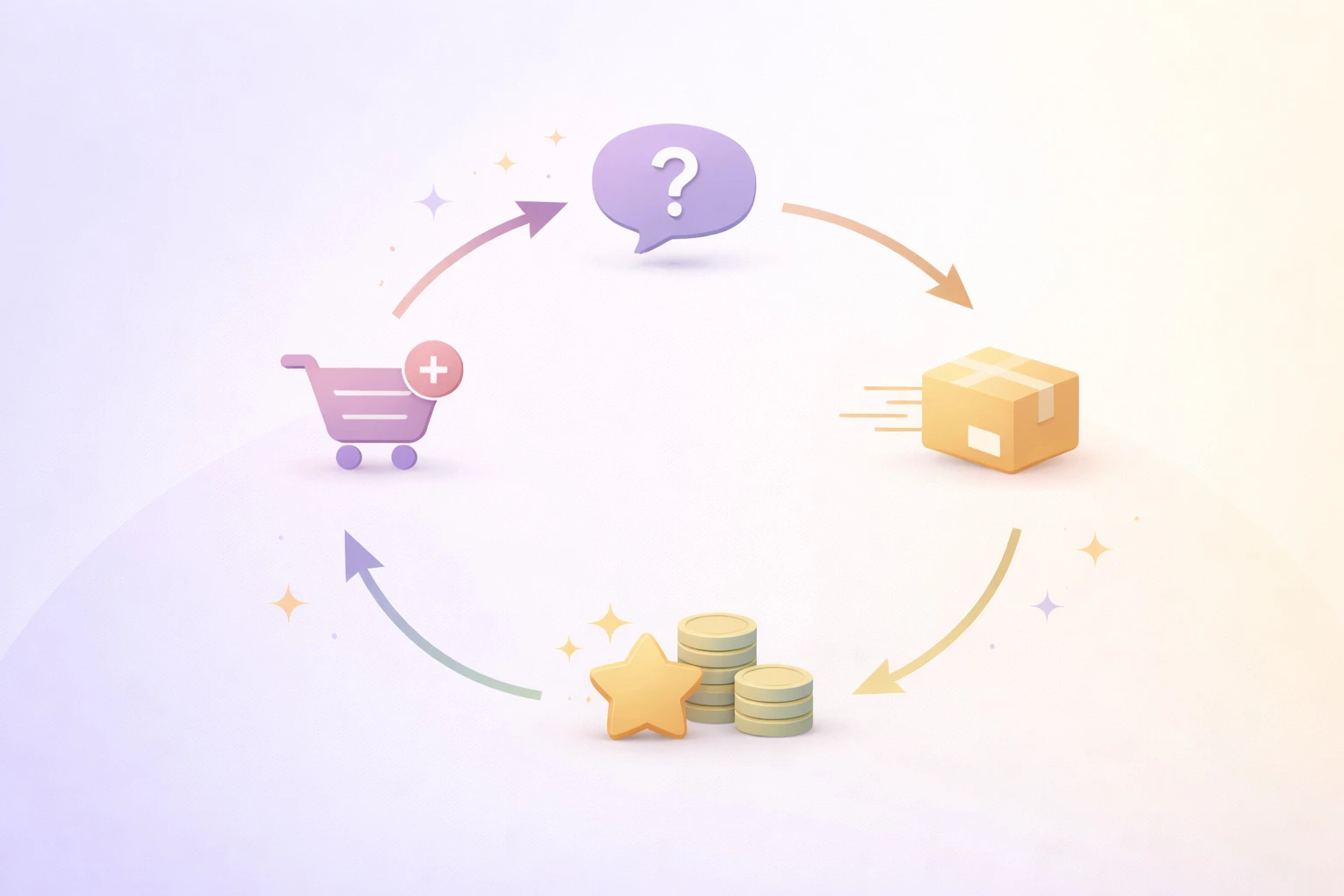
These moments build retention in e-commerce
Why Post-Purchase is Strategically Undervalued
In many organizations, post-purchase support is categorized as operational overhead. Teams are measured on ticket closure rates and response times — not on trust impact or customer lifetime value (LTV).
This framing underestimates its influence.
This is where product promises are tested.
Brand reliability is evaluated.
Expectations finally meet reality.
If acquisition represents persuasion, post-purchase represents proof.
Brands invest heavily in making the sale. Few invest proportionally in protecting the relationship afterward.
That imbalance becomes increasingly expensive as CAC rises.
The Hidden Gold in Support Conversations: Brand Insight
There’s another advantage to investing in post-purchase infrastructure that many D2C founders overlook:
Strategic insight.
Your marketing dashboard tells you what converted.
Your support inbox tells you what’s broken.
Ads show you CTR, CAC, ROAS.
But the journey after checkout reveals what confused, frustrated, or disappointed customers after they paid you.
And that’s where real leverage sits.
Inside post-purchase interactions are signals you’re probably ignoring:
“Is this true to size?” → Product clarity gap
“I thought it would arrive in 2 days.” → Expectation mismatch
“Your return policy is complicated.” → Policy friction
“Tracking link not working.” → Trust breakdown moment
These aren’t just support tickets.
They’re diagnostic reports on your eCommerce business.
Every WISMO message.
Each exchange request.
Even refund reasons.
This is zero-party data — emotionally honest feedback customers voluntarily give you.
When structured properly, it becomes a powerful customer retention strategy:
Customer friction → Product or UX refinement → Fewer returns → Fewer tickets → Higher confidence → Higher LTV.
Post-purchase is not reactive.
It is strategic intelligence.
Does Investing in Post-Purchase Experience Reduce Sales?
It does the opposite.
Customers who trust a brand’s resolution process feel more comfortable purchasing again.
Confidence lowers hesitation.
Familiarity increases exploration.
Strong post-purchase systems reduce friction before the next purchase even begins.
Lifecycle growth is cumulative. You cannot sustainably optimize acquisition while neglecting what happens afterward.
Post-purchase experience in eCommerce does not compete with revenue.
It compounds it.
The Continuity Problem in Modern eCommerce
Customers experience their journey as one continuous thread.
Brands often manage it across disconnected systems.
A shopper may move from:
Website chat → Email support → Messaging app → Account portal
From the brand’s perspective, these are systems.
From the customer’s perspective, they are interruptions.
Continuity — preserving identity, context, and conversation in one cohesive interface — reduces friction and builds trust.
Fragmentation erodes it.
Seamless post-purchase support is not a feature. It’s infrastructure.
Where the Real eCommerce Experience Begins
A transaction is not the end of the journey.
It’s the beginning of the post-purchase experience.
After checkout, customers are still watching, waiting and forming an opinion about your brand.
In the delivery updates, exchanges, returns, and small moments of uncertainty — that’s where trust is built quietly.
The journey doesn’t stop at conversion. It extends beyond it.
And the brands that truly grow understand this:
Retention is not built in campaigns.
It’s built in the post-purchase experience.
Want to see this in action ?
You are already losing if you are not paying attention to your post-purchase experience.
Want to know how you can leverage AI for your customer support? Schedule a call.
Leave a Reply